

A building pad is a level, compacted platform of dirt for a house, a shop or a barn, cut and filled to the grade your builder needs and shaped so water runs away from it. Getting the survey, the permits and the dirt right before the foundation goes in is far easier than fixing settling or water problems afterwards.
What a building pad is and why it matters
A building pad is the prepared ground a foundation sits on. On a sloped lot the high side is cut down and the low side is built up with fill; on a flat lot the pad may be raised so it sits above the surrounding ground. Either way, the finished pad should be level where the building goes, firm enough not to settle, and higher than the ground around it so water drains away.
Most of what goes wrong with a slab or a shop floor later traces back to the pad: soft spots that were never compacted, organic topsoil left underneath, or a pad that ended up lower than the yard so water runs toward it. Dozer work done right at the start heads off those problems, and it is the core of dozer work, grading and lot leveling.
Before the machine shows up
For a building pad, a survey is usually worth having, and for anything near a property line it is important. Your builder or plans will set the pad size and finished elevation. Inside Tulsa city limits, the City says a Watershed Development Permit is required before development that includes earth change, excavating or grading, and that development in or next to a regulatory floodplain needs review by the Floodplain Administrator.
The City offers a free floodplain determination through 311 if you give the address and the subdivision, lot and block. Outside the city, ask your town or Tulsa County which permits apply, and confirm before any dirt moves. Underground lines are located through OKIE811 at least three business days ahead; see the OKIE811 guide.
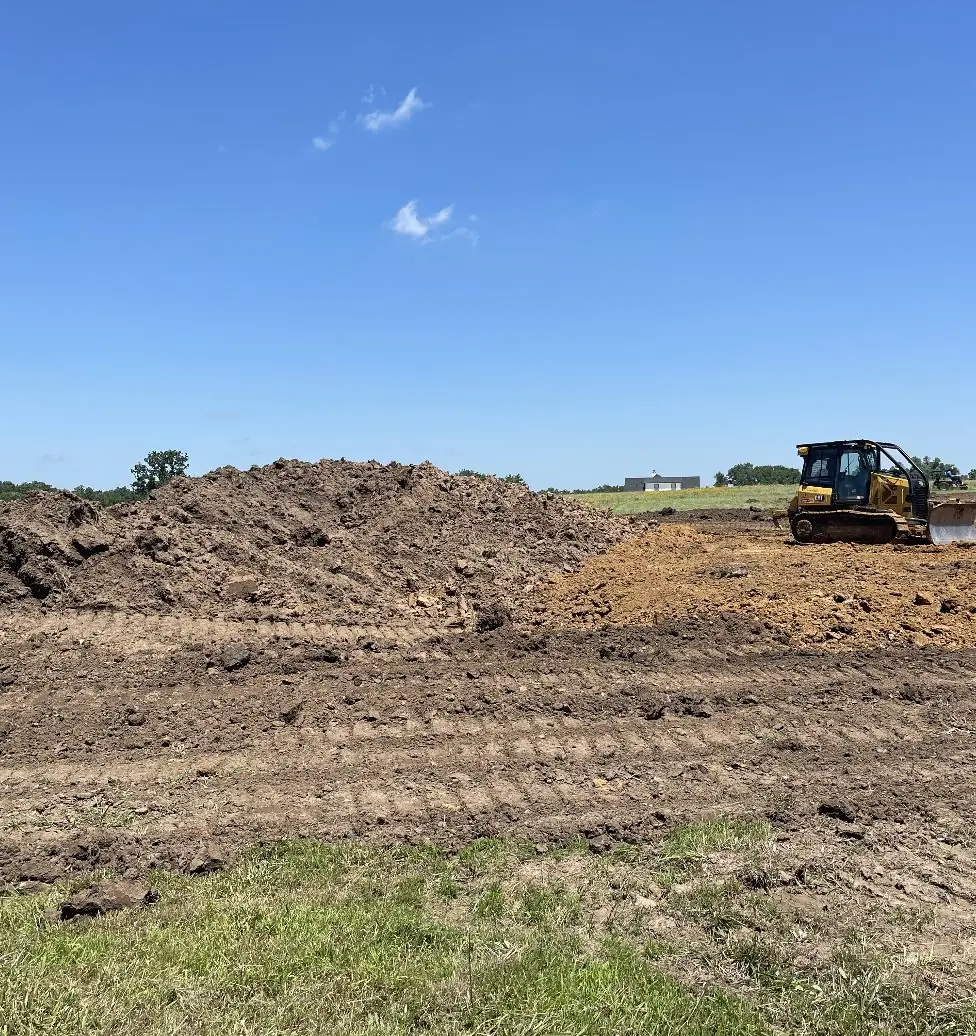
Clearing and stripping the site
Trees, brush and stumps come off the footprint and the working area first, along with room for access. That is land clearing, and it is often done in the same visit as the pad.
Then the topsoil is stripped. Topsoil is full of roots and organic matter that rot and compress over time, which is exactly what you do not want under a slab. It is pushed aside and saved, because it is useful later for dressing the slopes around the pad and getting grass to grow. Skipping this step to save a little time is one of the most common reasons a pad settles unevenly.
Cut, fill and compaction
With the site stripped, the dozer cuts down the high ground and pushes that dirt into the low side. Where the site does not balance, fill can be brought in or worked with what is already there, and which is the better choice depends on the property.
Fill is placed in thin layers and compacted one layer at a time rather than dumped in one deep pile and run over at the end. Compacting in layers is what makes the whole pad firm instead of only the top. Moisture matters too, especially with clay, which compacts poorly when it is too dry or too wet. Where your builder or an engineer has set compaction requirements for the foundation, those specifications govern, and testing can be arranged with whoever the builder uses.
Shaping for drainage around the pad
A pad that sits level but lower than the yard around it will collect water against the foundation. The finished pad should stand above the surrounding grade, with the ground around it shaped to fall away and carry water to a ditch, a swale or a lower part of the lot. On a hillside, a shallow swale above the pad can turn uphill water around it before it arrives.
This is the moment to think about the driveway and drainage too, while the machine is on site. A drive to a new shop or house is usually cut and based at the same time; see driveway installation. If the site is wet, drainage and French drains can be planned in before the slab is poured rather than retrofitted later.
Checking your soil before you build
The USDA Natural Resources Conservation Service runs the Web Soil Survey, where you can draw your property on a map, read the soil description and see how those soils are rated for uses such as building sites and dwellings. It is a useful first look, especially on rural acreage where nobody has built before.
It does not replace what comes out of the ground. Rock close to the surface, soft wet pockets, and old fill or buried debris from a previous building only show up once the dozer starts cutting. If anything unexpected turns up, it is better to stop and talk about it than to bury it under a pad.
Plan your pad with Justin
Justin cuts, fills and compacts building pads for houses, shops and barns across Tulsa, Broken Arrow, Owasso, Bixby, Coweta and the rural ground around them. On a walk-through he will look at the slope, the access, where the spoil can go, how water moves across the site and what your builder needs.
Have your survey and plans handy if you have them, along with any floodplain determination or permit notes from the City or county. Call Justin at (918) 240-3392 to set up a walk-through and get your pad, your drive and your drainage planned together.
The Short Version
- A building pad is cut, filled and compacted level, and set higher than the ground around it.
- Get a survey, check permits with the City of Tulsa, your town or county, and call OKIE811 before work.
- Strip the topsoil and compact fill in layers; skipping either is a common cause of settling.
- Plan the driveway and drainage while the dozer is on site.
- Your builder's or engineer's specifications govern the pad; Justin builds to them.
Quick Answers
How long should a new pad sit before the slab is poured?
That depends on the fill, the compaction and the foundation design, so it is a question for your builder or engineer. A pad compacted properly in layers is ready much sooner than loose fill left to settle on its own.
Should the topsoil be removed before a building pad is built?
Yes, in nearly every case. Topsoil holds roots and organic matter that break down and compress over time. It is stripped, saved and spread back on the slopes around the finished pad.
Can a building pad be raised to get it out of the wet?
Often, yes. Raising the pad above the surrounding ground and shaping the yard to fall away is a common fix on flat or wet lots. If the property is near a mapped floodplain, check with the City or county first.
Does the City of Tulsa require a permit to grade a building pad?
The City lists earth change, excavating and grading under its Watershed Development Permit. Ask through 311 or Development Services about your lot before any work starts.
See the dozer work service or call (918) 240-3392.