

Burying downspouts is usually a good idea when roof water is soaking the ground beside your foundation and there is a lower spot on the lot where a buried pipe can let it out. The line only has to be deep enough to keep a steady fall all the way to that outlet and stay clear of mowers and foot traffic, so the outlet sets the depth more than any rule of thumb does.
Is it a good idea to bury downspouts?
Often, yes. A roof sheds a lot of water in a short time and sends it to a few downspouts. If those empty at the base of the wall, the ground there stays wet, and on Tulsa clay that water has nowhere quick to go. A buried line carries it away out of sight, with no splash blocks or plastic extensions to trip over or mow around.
It is a bad idea when there is no lower place for the water to come out. A buried pipe with no outlet just moves the puddle, or backs up and overflows at the gutter. A line laid without enough fall can also hold water, collect leaves and grit, and freeze on a cold night. So the honest answer is that burying downspouts works when the route and the outlet work, and that is the first thing to check.
How deep should a downspout drain be buried?
There is no single right depth. The pipe has to run downhill from the downspout to the outlet the whole way, with no flat spots or bellies where water can sit. That fall decides the depth. Near the house the trench can be fairly shallow, and along the route it follows the yard, getting deeper where the ground rises and shallower where it drops toward the outlet.
The line should be covered well enough that sod grows over it and a mower or a foot will not crush it. Where it crosses under a drive or a path it needs more protection. It should not be so deep that the end of the pipe sits below the ground where it is meant to come out. Tulsa winters are mostly mild, but hard freezes do come, and a line that drains itself empty after every rain is the real protection against freezing, more than extra depth.
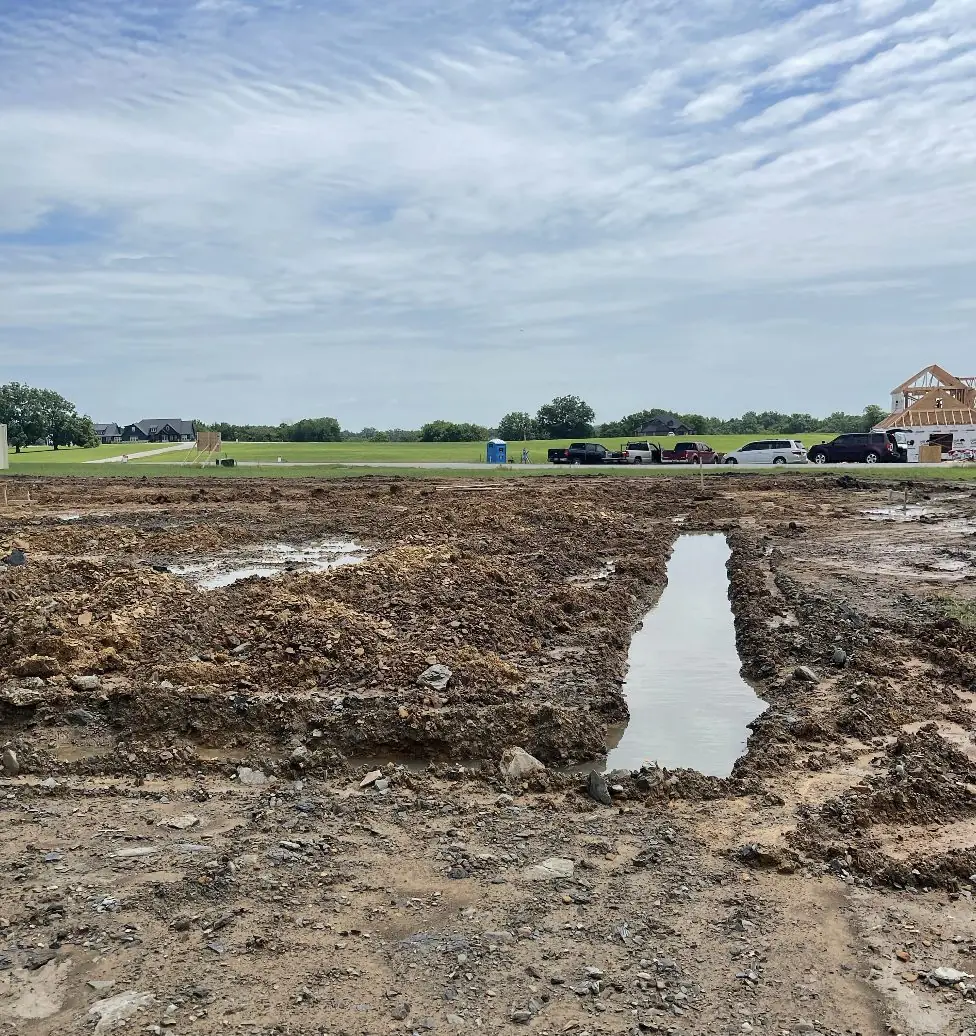
Use solid pipe, not a French drain
Roof water belongs in a solid pipe. A perforated French drain pipe lets water back out into the ground along its length, which is the opposite of what you want next to a foundation. It also floods a French drain with leaves and roof grit it was never built to carry. Downspouts and French drains can share a trench or an outlet, but they should be separate pipes.
Smooth-wall pipe is easier to clean than corrugated pipe, which has ridges that catch debris. A strainer or leaf guard where the downspout meets the pipe keeps most of the gutter trash out, and a cleanout along the route means a clog can be reached without digging. If several downspouts join one line, the main run has to be big enough to carry all of them in a heavy storm. The yard drainage guide covers where roof water fits among the other causes of a wet yard.
Where the water comes out
Every buried downspout line needs a legitimate outlet. That can be daylight at a lower point on your own lot, a pop-up emitter set in the lawn well away from the house, a ditch, or an existing storm outlet. It should never empty onto a neighbour's property, and roof water should not be run into a sewer cleanout.
Some homeowners want the line run out to the street curb. Ask the City of Tulsa through 311 before anything touches the curb, the sidewalk or the street. The City says cuts into the public right-of-way for utility connections need a separate Right of Way Permit, so confirm what applies to a drain line at your address. Outside city limits, ask your town hall or Tulsa County. Rules differ from one city to the next, so get the answer from the office that covers your property.
What moves the cost of running downspouts underground
The cost to run downspouts underground depends on how many downspouts there are, how far each has to travel to the outlet, and how deep the trench has to go to keep the fall. A short run on open, gently sloping lawn is a small job. A long run around the house to the only low spot on the lot is a much bigger one.
What is in the way matters just as much. Driveways, sidewalks, patios, fences, tree roots and buried utility lines all slow the digging, and some have to be bored under or cut and patched. Access matters too: a machine is faster than hand digging, but only where it fits. Rock in the trench, the type of outlet, the number of cleanouts and how much lawn has to be put back all feed into the final number, which is why a quote comes from walking the route.
Check these before you bury anything
Start with the gutters. If they overflow because they are clogged or too small, burying the downspouts will not catch the water spilling over the edge. Clean them and watch them in a hard rain. Sometimes a longer extension or a simple splash pad set further out does the job and no trench is needed.
Then look at where the rest of the water comes from. If the yard itself falls toward the house, buried downspouts will help but will not stop surface water running back to the wall. That is a grading problem, covered in the French drain vs regrading guide. Before any digging, locate requests go in through OKIE811 so the utility companies can mark their lines; the OKIE811 guide explains how. Private lines, such as a sprinkler system or a line out to a shop, are yours to find.
Have Justin walk the route
Justin walks from each downspout to the place the water can legitimately leave, checks that there is enough fall to get it there, and notes what is in the way. You get a plain answer on whether buried lines are the right fix or whether an extension, a swale or a French drain would do more good. If a buried line is the answer, the trench is dug, the pipe is laid with steady fall, and the trench is backfilled and compacted so it does not sink into a groove across your lawn.
See underground drainage in Tulsa for the service itself. To set up a walk-through anywhere around Tulsa, Broken Arrow, Jenks, Bixby or Owasso, call Justin at (918) 240-3392.
The Short Version
- Burying downspouts works when there is a lower outlet on the lot for the water to reach.
- Depth is set by steady fall to the outlet, not by a fixed number.
- Roof water goes in solid pipe, kept separate from any French drain.
- Ask the City of Tulsa through 311 before running a line to the curb or street.
- Cost follows the number of downspouts, the length of run and what is in the way.
Quick Answers
Can several downspouts be joined into one buried pipe?
Yes, as long as the main line is big enough to carry all of them in a heavy storm and keeps steady fall to the outlet. Too small a main is a common reason buried downspouts back up and overflow at the gutter.
Does a buried downspout line need a cleanout?
It is worth having one. Leaves and roof grit get past strainers, and a cleanout lets a clog be flushed or reached without digging up the yard to find it.
Why does water bubble out of the ground along my buried downspout line?
Usually the line is clogged, crushed or has lost its fall, so water backs up and finds a weak joint. The outlet is the first thing to check, because a buried or blocked outlet stops the whole line.
Do I need to contact OKIE811 before burying a downspout line?
Yes. Any digging in Oklahoma should start with a locate request through OKIE811, made at least three business days ahead, so utility companies can mark their lines. Confirm the details with OKIE811 when you submit the request.
See the drainage & french drains service or call (918) 240-3392.