

A pond that holds water starts with the right site and the right soil: enough runoff to fill it, and enough clay to seal the basin and build a sound dam. Check both before anyone digs, use the free planning help NRCS offers, and confirm dam rules with the Oklahoma Water Resources Board.
Start with the site, not the shovel
Oklahoma State University Extension's fact sheet on building a pond is blunt about it: many sites are not suitable, and it is better to find that out early. A pond stays full on runoff from the land that drains into it, so the watershed has to be big enough to fill the basin. Too big is a problem too, because a large flow can flush the pond and overload the spillway.
The Oklahoma Department of Wildlife Conservation advises against damming creeks or large draws, and notes that eastern Oklahoma needs less drainage area per acre of pond than the drier west. OSU also warns against sites with pollution sources in the watershed, flood-prone spots and certain problem soils. A well-vegetated watershed is generally the better source of water.
Soil decides whether it holds water
Whether a pond holds water comes down to the soil. Clay or clay loam seals the bottom and builds a tight dam; sandy or gravelly ground leaks. ODWC says that where a site does not have enough clay, clay has to be hauled in for the bottom and the dam core. OSU describes a quick field check called the ribbon test, and recommends digging test holes on a grid across the basin, below the planned bottom, to find hidden rock, gravel or sand before committing.
The USDA Natural Resources Conservation Service's Web Soil Survey is a useful first look at the soils mapped on your land. It is a starting point; the test holes tell you what is actually there. OSU also notes that sealing a leaky pond after the fact is hard work and not a sure fix, which is why the soil is checked first.
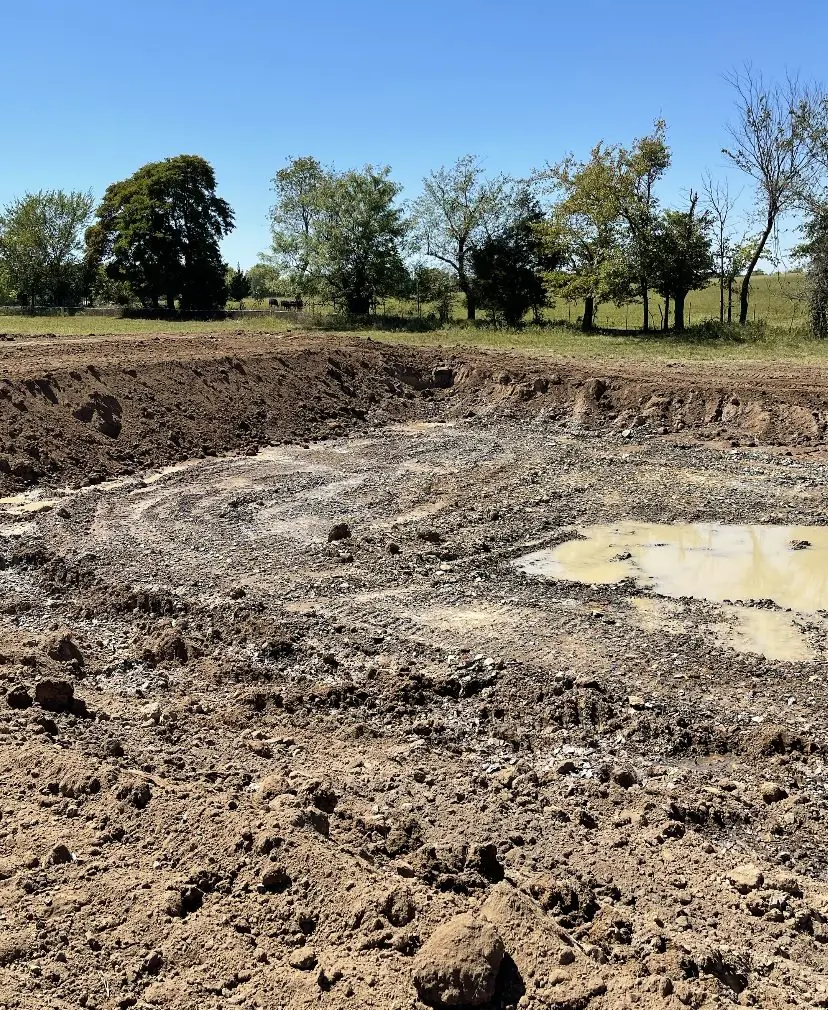
Get the free planning help
Both OSU Extension and ODWC point landowners to the Natural Resources Conservation Service for pond planning, and OSU notes that NRCS services are free. NRCS can help with soils, storage, the size of the watershed and spillway design, and can tell you whether cost-share help might be available, though OSU says pond cost-share is rare. A private civil engineering firm is the other route.
Oklahoma's local conservation districts, supported by the Oklahoma Conservation Commission, work alongside these programs, and the Commission keeps a directory of district offices. Call the district or the NRCS service center for your county early, before you have settled on a spot. Their advice on the site and the dam is worth having in hand when you talk to whoever will dig it.
Building the dam
OSU's fact sheet describes the basics. The topsoil is stripped from under the dam and saved for dressing the finished slopes. A core trench is cut along the centreline of the dam and filled with well-compacted, high-clay soil to cut off seepage underneath. The dam is then built up in thin compacted layers, using a sheepsfoot roller or dozer tracks rather than a smooth roller, with no rock, branches or organic trash mixed in.
Both OSU and ODWC say to keep trees off the dam, because roots can open seepage paths. Grass is what belongs on it. These steps are where a lot of the dozer time goes, and they are the difference between a dam that holds and one that weeps every summer. Dozer work covers the machine side of shaping and compacting.
Spillways, drains and depth
OSU describes a principal spillway that takes normal overflow and a higher auxiliary spillway for heavy rain. ODWC recommends a wide, flat spillway so floodwater runs over it shallow. Both point to a bottom drain, which lets the pond be lowered for repairs or fish management; OSU adds that pipes through the dam need anti-seep collars and careful tamping.
For depth, OSU advises keeping large shallow areas to a minimum, because shallow water grows weeds, and keeping banks sloped gently below the waterline. ODWC adds that part of the pond should be deep enough to carry water through dry years. Extra depth beyond what the watershed can fill only adds cost and leak risk. Your NRCS or engineering plan should set these for your site.
Permits and the OWRB dam rules
The Oklahoma Water Resources Board runs the state Dam Safety Program. Larger dams need an OWRB permit before construction, enlargement, alteration, repair or removal. The OWRB also describes an agriculture-exempt category for smaller, low-hazard dams used mainly for agriculture, but those must be designed or built with help from a local conservation district or a federal agriculture agency.
If you are unsure whether your dam needs a permit, the OWRB says to contact its Dam Safety Program, so do that and confirm before work starts. OSU also notes that NRCS and private engineers can advise on federal, state and local requirements, including wetland protection and the Clean Water Act. Underground lines are located through OKIE811 before any digging.
New pond or old pond, start with a walk-through
Many pond calls are not new digs at all. A pond that has gone shallow and weedy is often silt rather than a leak, and cleaning it out can bring it back without starting over. Dams that seep and spillways that have cut a new path can often be repaired. Pond excavation and clean-out covers both new ponds and old ones, and brush around a new pond site is handled with land clearing.
Justin checks the soil on site before telling you a pond will hold. Bring your NRCS or engineering plan if you have one, and call Justin at (918) 240-3392 to walk the site and talk through the dig, the dam and where the spoil will go.
The Short Version
- Pick a site with enough runoff to fill the pond, without damming a creek or a large draw.
- Clay soil is what holds water; dig test holes before committing to a site.
- NRCS offers free pond planning help; your local conservation district can point you there.
- Build the dam with a clay core trench and thin compacted layers, and keep trees off it.
- Larger dams need an OWRB permit; contact the OWRB Dam Safety Program to confirm.
Quick Answers
How do I know if my land has enough clay for a pond?
Start with the Web Soil Survey, then dig test holes across the planned basin below the bottom elevation, as OSU Extension recommends. NRCS can help interpret what you find before you commit to the site.
Do I need a state permit to build a farm pond in Oklahoma?
Larger dams need an Oklahoma Water Resources Board permit, and smaller agricultural dams have specific exemption conditions. Contact the OWRB Dam Safety Program to confirm for your site before work starts.
Can NRCS help me design a pond on my property?
OSU Extension and ODWC both point landowners to NRCS for pond planning, and OSU notes NRCS services are free. Contact the NRCS service center or conservation district for your county.
Why shouldn't trees grow on a pond dam?
Both OSU Extension and ODWC advise keeping trees off the dam because roots can create seepage paths through it. Grass is the recommended cover.
See the pond excavation service or call (918) 240-3392.