

The cost to dig a pond in Oklahoma is set by how much dirt has to move, whether the soil on site will hold water, and how big the dam and spillway need to be, more than by the surface area you picture. A site visit that looks at the soil, the drainage area and the access is the only way to turn those into a real number.
Why online pond prices rarely fit your land
Two ponds that look the same size on a map can cost very different amounts. One sits in a natural draw on clay that seals itself, with spoil that goes straight into the dam. The other is on flat, sandy ground with timber to clear, clay to bring in and spoil to haul. A figure from another state, or from someone else's farm, tells you little about yours.
What a contractor is really pricing is machine time and the work that goes with it: clearing, digging, shaping, compacting, building the dam and spillway, and dealing with the spoil. The sections below are the things that move each of those up or down, so you can see why a walk-through comes before a number.
Size, depth and the dirt that moves
The biggest single factor is volume: how much dirt comes out of the basin and where it goes. Depth adds up quickly, because every extra foot down across the whole pond is a lot more dirt. Steep inside slopes move less dirt than gentle ones, but the shape has to suit what the pond is for, whether that is livestock water, fishing or looks.
Where the dirt ends up matters as much as how much there is. Spoil that builds the dam or a nearby pad or approach is dirt moved once. Spoil that has to be spread over a pasture or hauled away is extra work. A pond sited where the dug dirt is useful costs less to build than one where it is in the way.
Soil that holds water
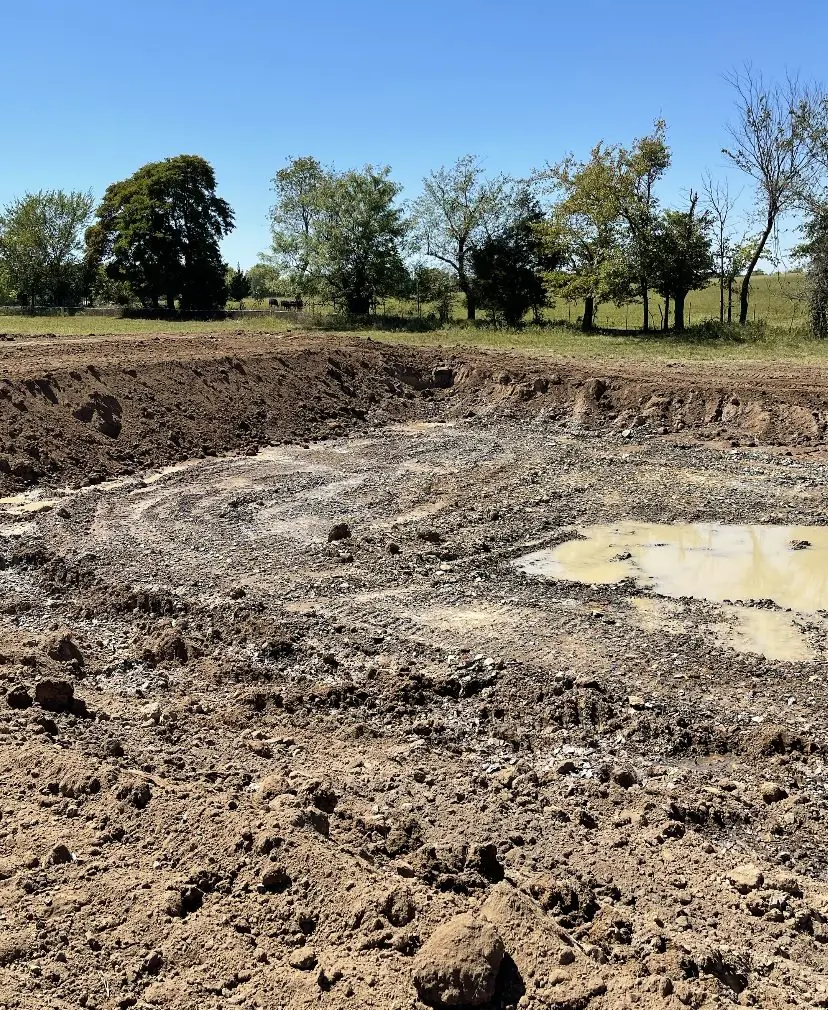
A pond only works if the basin and the dam hold water, and that comes down to clay. Where the native soil has enough of it, the basin can seal with careful compaction. Where it does not, clay may have to be found elsewhere on the property or brought in, which adds digging, hauling and compacting.
Checking the soil before committing is the surest way to avoid a pond that never fills. Test holes in the basin and the dam line show what is down there. The pond building guide covers soil and site checks in more depth. OSU Extension names three agencies that offer technical help with ponds: the Oklahoma Department of Wildlife Conservation, OSU Extension and the Natural Resources Conservation Service.
The dam, spillway and pipe
On most farm ponds the dam is where much of the work is. It has to be keyed into the ground, built up in compacted layers from good clay, and shaped so it does not slump or seep. A taller or longer dam means more dirt and more compaction time. A spillway that carries storm water around the dam without cutting it out, and any pipe through the dam, add their own work.
Size can also bring rules. The Oklahoma Water Resources Board says plans for building or modifying dams of jurisdictional size must be reviewed and approved before work begins. OSU Extension notes that dam and spillway problems are normally handled by NRCS engineers and pond technicians. Ask the OWRB whether your dam would fall under its program before you plan around it.
Site, access and clearing
Timber and brush in the pond footprint or on the dam line have to come off before digging starts, and roots do not belong in a dam. The land clearing needed can be a small part of the job or a big one, depending on what has grown up.
Access matters too. A site the machines can reach across dry pasture is faster than one down a steep, wooded slope or across a creek. Wet ground slows everything, and a draw that holds water in spring may need to wait for a dry spell. Distance from the road, gates, fences and any buried lines along the route all feed into the time on site. A locate request through OKIE811 comes before any digging.
Help that can lower what you pay
The Oklahoma Conservation Commission runs a state-funded conservation cost-share program, managed through the local conservation districts. Whether a pond qualifies depends on the program, the year and what the pond is for, so ask your county conservation district rather than assuming. NRCS also offers planning help and runs its own programs for landowners.
Even where no money is available, the free planning help is worth having. A sound design that fits your soil and your drainage area costs less over the life of the pond than one that leaks, silts in or loses its spillway in the first big storm. Start those conversations early, because programs often have application windows.
New pond or clean-out: get a real number
If you already have a pond that has gone shallow and weedy, digging the silt out usually costs far less than starting over somewhere else. The pond clean-out guide covers how that work is done.
For a new pond, Justin walks the site, looks at the dirt, the draw and the way in, and talks through size, depth, the dam and where the spoil will go. You get a straight answer on whether the ground will hold water before anything is promised. See pond excavation for the service, and call Justin at (918) 240-3392 to set up a site visit anywhere around Tulsa and northeast Oklahoma.
The Short Version
- Pond cost follows the dirt moved, the soil and the dam, more than the surface area.
- Spoil that builds the dam or a pad is dirt moved once; spoil hauled away adds work.
- Check the soil for clay before committing to a pond site.
- Ask the OWRB whether your dam is of jurisdictional size before planning around it.
- Ask your county conservation district and NRCS about cost-share and planning help.
Quick Answers
Does it cost less to clean out an old pond than to dig a new one?
Usually. A pond that has gone shallow is normally full of silt, not leaking, and digging it back out reuses the dam and basin that are already there. A walk-through confirms whether the dam and spillway are still sound.
Which affects pond cost more, size or depth?
Both feed into the volume of dirt moved, and depth adds up fast because it applies across the whole basin. The dam and the soil can matter even more than either.
Can a conservation district help pay for a farm pond in Oklahoma?
Sometimes. The Oklahoma Conservation Commission runs a state cost-share program through conservation districts, and NRCS has its own programs. Ask your county conservation district what is open and whether a pond qualifies.
What makes one pond quote higher than another for the same site?
Different assumptions about the soil, the dam, the spillway, clearing and where the spoil goes. Ask each contractor how they plan to seal the basin and build the dam, and compare those answers, not just the totals.
See the pond excavation service or call (918) 240-3392.