

Most yard drainage problems in Tulsa come down to three things: ground that slopes the wrong way, roof water dumped in the wrong place, and slow-draining soil that cannot take in a heavy rain. Find which one you have, give the water a legitimate place to go, and the problem usually stops.
Signs your yard has a drainage problem
Some signs are obvious: a pond in the lawn after every storm, a soggy strip that never dries out, or mud where grass used to grow. Others are easy to miss until they cost money. Look for water marks or damp along the bottom of a wall, a musty crawlspace, soil washed out from under a patio or walk, mulch and gravel swept into one corner, or gaps opening between the ground and the foundation.
Gutters overflowing at one corner, downspouts that empty right at the house, and puddles that sit against the slab are all early warnings. None of them fix themselves. Water that keeps arriving at a foundation tends to cause bigger trouble over time, so it is worth sorting out while it is still a yard problem.
Cause one: ground that falls the wrong way
Ground around a house should fall away from it. On a lot of homes it no longer does. Fill dirt placed against a new foundation tends to settle in the years after the builder leaves, and the slope that ran away from the walls can end up running toward them. Flower beds built up with edging, patios poured flat, and sidewalks that have sunk can all trap water against the house.
This is a common pattern on newer subdivision lots, where the whole lot was shaped by machine and then landscaped over. The fix is reshaping the surface so it drains again. That is grading and lot leveling work rather than plumbing, and it is often the simplest answer if the surface is the problem.
Cause two: roof water with nowhere to go
A roof collects a lot of water in a short time and sends it to a handful of downspouts. If those downspouts empty at the base of the wall, all of that water lands exactly where you do not want it. Clogged gutters do the same thing by spilling over the edge.
Sometimes the fix is as simple as cleaning gutters and extending downspouts so they discharge well away from the house. Where the yard is tight or the water needs to travel further, downspouts can be tied into a buried solid pipe that runs to an outlet. Roof water should not be tied into a perforated French drain line in most cases, because you want it carried away, not let back out into the ground along the route.
Cause three: soil that drains slowly
Clay soil has tiny pore spaces and takes in water slowly. When rain comes faster than the ground can absorb it, the extra runs off or sits on top, and the low spots in the yard fill up. In a dry spell clay can crack and drink water quickly, so a yard can seem fine in late summer and stay wet through spring.
The USDA Natural Resources Conservation Service runs the Web Soil Survey, a map where you can look up the soil described for your property. Where the soil itself is the issue, the fixes are getting surface water off the lot with grading and swales, and collecting what soaks in with a French drain. The French drain vs regrading guide covers how to tell those two apart.
Yard drainage solutions, from simple to involved
Start with the simple things: clean gutters, extend downspouts and pull back any soil, mulch or edging that is trapping water against the house. If that does not do it, the next step is usually a swale, which is a shallow, grassed channel shaped into the yard to carry surface water around the house to a lower point.
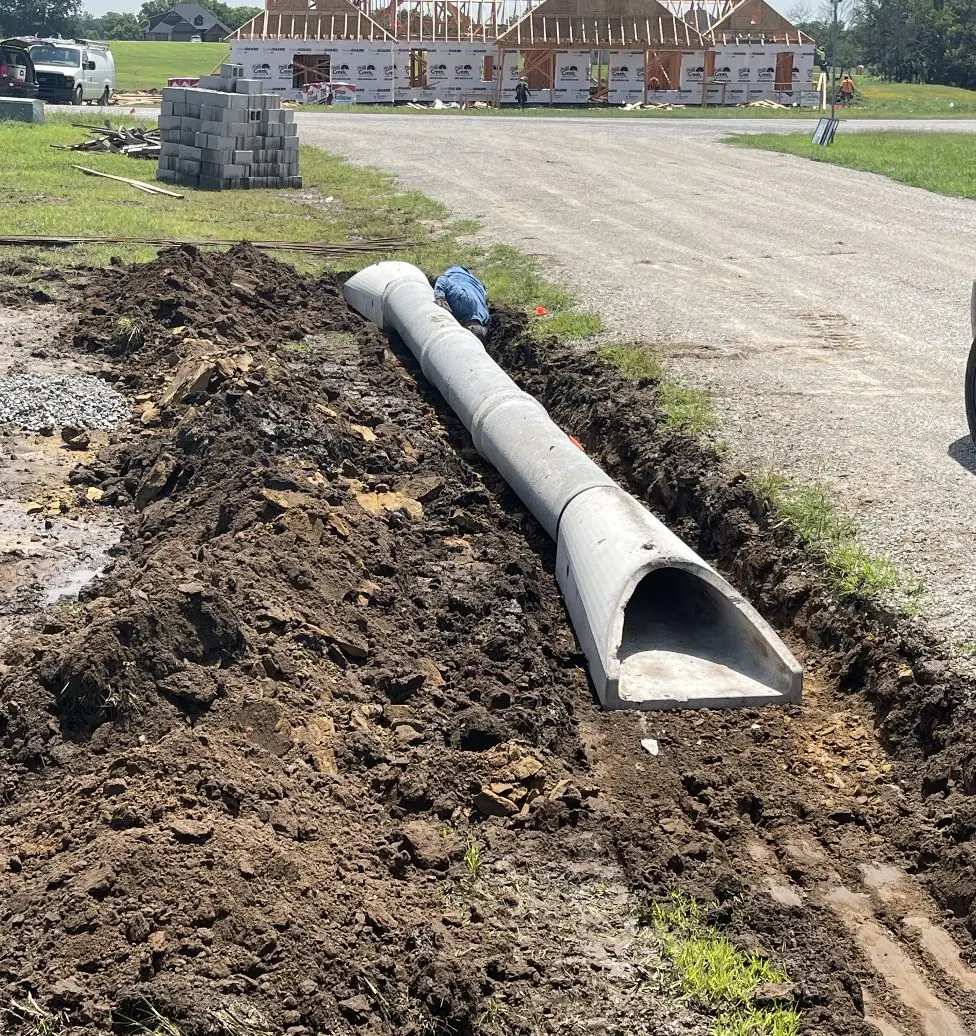
Beyond that comes regrading a larger area, and then French drain installation where water needs to be collected below ground. Culverts and ditches come into it where a driveway or a road is in the way. Each step up involves more digging, which is why it pays to have someone look before you choose. Whatever is built, it needs an outlet: daylight at a lower point on your lot, a ditch, or an existing storm outlet, never your neighbour's yard.
Who to call at the City of Tulsa
The City of Tulsa says its stormwater engineers can make site visits and recommend ways to address private drainage problems. Ask through 311. The City also offers a floodplain determination at no charge, which tells you whether your property is in the mapped flood hazard area; you give the address and the subdivision, lot and block.
If a storm drain inlet in your street is blocked with leaves or debris, the City asks residents to report it to 311. Before any regrading or excavating, ask the City whether a Watershed Development Permit applies, since the City lists earth change, excavating, grading and regrading under it. Outside city limits, ask your town or Tulsa County. And before anyone digs, locates go in through OKIE811; see the OKIE811 guide.
Have Justin walk the yard
Justin traces the water from source to exit and notes what stands in the way before recommending anything. Sometimes that means a drain, sometimes regrading, sometimes both, and sometimes just a downspout and a swale. You get a straight answer about which one fits, what the route and outlet would be, and how the yard will be left once the work is done.
If you can, take short phone videos during the next heavy rain and have them ready. Call Justin at (918) 240-3392 to set up a walk-through anywhere in Tulsa, Broken Arrow, Jenks, Bixby, Owasso and the towns around them.
The Short Version
- Most Tulsa yard drainage problems trace back to grading, roof water or slow-draining clay.
- Start simple with gutters and downspouts, then swales, regrading and French drains as needed.
- Every fix needs a legitimate outlet that does not send water onto a neighbour.
- The City of Tulsa offers stormwater advice and free floodplain determinations through 311.
- Rain videos and a walk-through with Justin get you to the right fix fastest.
Quick Answers
Can the City of Tulsa look at a drainage problem on my private lot?
The City says its stormwater engineers can make site visits and recommend ways to address private drainage problems. Call 311 to ask and confirm what they can do for your address.
Should my downspouts go into a French drain?
Usually not into the perforated part. Roof water is usually carried away in a solid pipe or discharged well clear of the house, so it does not get let back into the ground along the drain line.
What is a swale and would one help my yard?
A swale is a shallow, grassed channel shaped into the ground to carry surface water around a house to a lower point. It helps where water runs across the yard in storms and there is a place downhill for it to go.
Why did my yard start holding water a few years after the house was built?
A common reason is settling. Fill against the foundation and across the lot sinks over time, and the slope that once ran away from the house can flatten out or reverse. Regrading usually puts it back.
See the drainage & french drains service or call (918) 240-3392.