

A French drain that stops working has usually lost its outlet, filled up with silt, or lost the fall it needs, and on Tulsa clay silt is a common culprit where the line was built without fabric or with the wrong rock. A drain that is sound can sometimes be cleared through a cleanout, but one that is clogged along its length usually has to be dug up and rebuilt, with the outlet fixed first.
Signs your French drain is not draining
The plainest sign is water back where it was before the drain went in: a soggy strip that never dries, a puddle over the line, damp at the foundation or in the crawlspace again. Look for a sunken groove or soft spots along the trench, and for grass that stays greener over the line than anywhere else.
The most useful test is free. Go out during a steady rain and look at the outlet. A working French drain should be letting water out after the ground around it has soaked up for a while. If the outlet is dry while the yard is wet, the water is not getting into the pipe or not getting through it. If you cannot find the outlet at all, that is the first problem to solve.
Start at the outlet
Most French drain repairs start at the end of the pipe. Outlets get buried by grass, mulch, soil washed down the yard or a new flower bed. They get crushed by a mower or a vehicle, packed with leaves, or plugged by animals that like a dry pipe to live in. A neighbour's new fence or regrading can leave the outlet lower than the ground around it, so the water has nowhere to go.
Clearing a buried or blocked outlet is the smallest repair there is, and sometimes it is the whole fix. A screen or grate on the end and a clear patch of ground around it help it stay open. If the outlet is clear and the drain still holds water, the problem is further up the line.
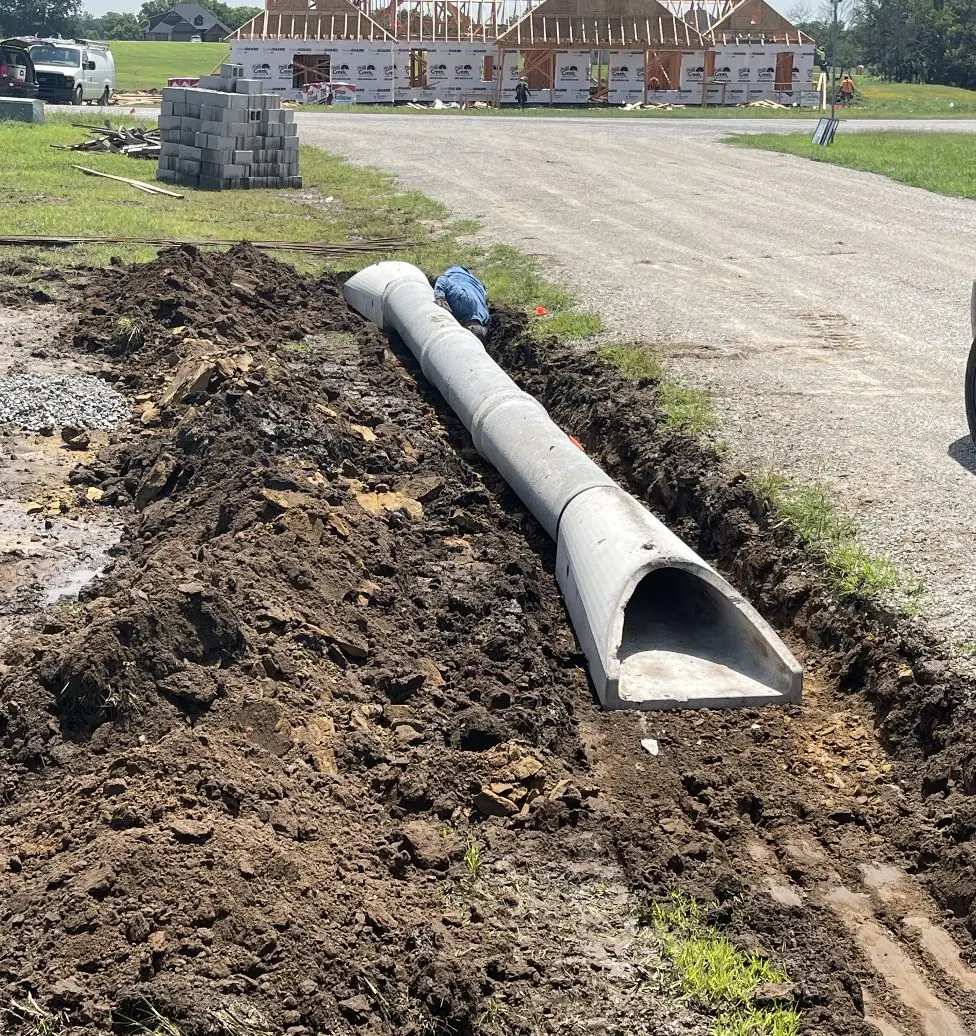
Silt, fabric and roots
Clay soil is made of very fine particles, and water carries them toward the drain. Without filter fabric wrapping the trench, those fines move into the gravel and then into the pipe, and over time the drain chokes. Fabric of the wrong type, or fabric wrapped tight around the pipe itself in fine soil, can clog its own surface and stop water getting in at all.
Rock matters too. Clean, washed drain rock leaves space for water to move. Rock with dirt and fines mixed in fills those spaces from day one. Roots are the other common invader. Trees and shrubs find the wet trench and grow into it, especially near the outlet. A camera run through a cleanout can show whether the pipe is full of silt or roots, and a plumber or drain cleaner with a camera can do that look.
Grade, sags and crushed pipe
A French drain needs steady fall from one end to the other. If the pipe was laid flat, or the trench settled and left a low belly, water sits in that low spot and drops its silt there. That section clogs first, and the drain upstream of it stops working even if the outlet is fine.
Pipe can also be crushed where vehicles cross it, where a later project dug through it, or where it was never bedded properly. Corrugated pipe in particular can flatten under load. These problems do not show from the surface, which is why a drain that has failed for no obvious reason usually needs to be opened up at a few points to see what has happened inside.
Downspouts tied into the drain
A lot of failed French drains were also carrying roof water. A downspout dumps a large volume of water in a short time, along with leaves and shingle grit, into a perforated pipe that was meant to collect slow ground water. It overloads in a storm and fills with debris between storms.
If your downspouts run into the French drain, a lasting repair usually separates them. Roof water goes into its own solid pipe to an outlet, and the French drain goes back to its own job. The guide to burying downspouts explains how those lines are laid out and why depth comes down to fall.
How a failed French drain is dug up and rebuilt
First the line is found and the utility marks are in. A locate request through OKIE811 comes before any digging, as the OKIE811 guide explains. Then the drain is opened at the outlet and at a few points along its length to find where and why it failed.
If the pipe is sound and only partly silted, flushing through a cleanout may buy it time. If it is full of silt, crushed or laid without fall, it gets rebuilt: the old rock and pipe come out, the trench is cut to steady fall, lined with fabric, bedded with clean rock, new pipe goes in with a cleanout, and the trench is wrapped and backfilled. The outlet is fixed so it stays open, then the ground is graded and put back. That is the same work as French drain installation, done on an old route.
Before you repair it, check it was the right fix
Sometimes a French drain fails because it was never the right answer. If water runs across the surface toward the house, a drain below ground will be overwhelmed every storm, and reshaping the yard may do more. The French drain vs regrading guide covers how to tell which you have, and plenty of yards need some of both.
Justin traces the water from where it comes from to where it can legitimately leave, opens up the old drain where needed, and tells you plainly whether a repair, a rebuild or a different approach makes sense. Take phone videos during the next heavy rain if you can, especially of the outlet. Call Justin at (918) 240-3392 to set up a look anywhere around Tulsa.
The Short Version
- Check the outlet in a steady rain first; a dry outlet in a wet yard points to a blockage.
- Silt from clay soil, wrong rock or wrong fabric is a common reason French drains clog.
- Low bellies and crushed pipe stop a drain even when the outlet is clear.
- Downspouts tied into a French drain should usually be separated during the repair.
- A drain full of silt is rebuilt to steady fall with fabric, clean rock and a cleanout.
Quick Answers
How do I find where my French drain comes out?
Walk downhill from the drain toward the low edge of the lot, a ditch or the street, and look for a pipe end or grate, often hidden in grass or mulch. If the builder or previous owner left a drawing, start there. If it cannot be found, that is often why the drain stopped working.
Can a clogged French drain be cleaned out instead of replaced?
Sometimes. If the pipe is sound, has a cleanout and is only partly silted, flushing can restore flow for a while. A pipe packed with silt or roots, crushed, or laid without fall usually has to be dug up and rebuilt.
How can I tell if my French drain was built without filter fabric?
Opening the trench at one point shows it quickly. If the gravel is packed with clay and the pipe has silt inside, the fabric is missing, torn or the wrong kind for the soil.
Does a French drain repair tear up the whole yard?
It disturbs the trench line. Opening a few test spots comes first, so the work is limited to the sections that failed where possible, and the ground is graded and put back afterwards.
See the drainage & french drains service or call (918) 240-3392.