

A gravel driveway is priced by the work it needs, not just its length: the ground underneath, how much base goes down, how the water is handled and how the drive meets the road. A drive built right the first time usually costs less over its life than one that has to be topped up every spring.
Why a price by the foot is misleading
It is tempting to price a gravel driveway by length alone, and online calculators do exactly that. The trouble is that two drives of the same length can be completely different jobs. One runs across firm, well-drained ground with an easy entrance; the other crosses a wet draw, needs the topsoil stripped and has to meet a county road over a ditch.
Most gravel drives that fail do so because the base was too thin or the water was never given a way off. Most of the real cost differences come from getting those two things right. The rest of this guide covers what sets the price, so you can read a quote and know what you are paying for.
Length, width and the ground underneath
Length and width set how much rock goes down, so they matter. A drive that has to take delivery trucks, a trailer or farm equipment needs more width and more base than one that only sees a pickup.
What is under the drive matters just as much. Topsoil and organic ground soften when wet, so they are usually stripped before base goes down. Clay can be firm when dry and soft when saturated, which affects how much base it takes to keep ruts from forming. Brush and trees along the route have to come off first; that is land clearing work. A drive across a slope may need cutting in, and one across a low area may need building up with fill. All of that is dirt work done before any surface rock shows up.
Base, surface rock and the crown
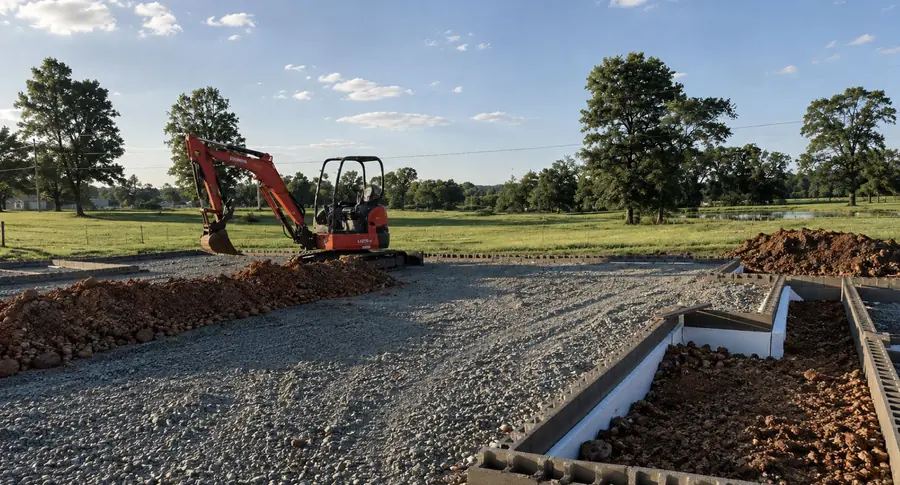
A lasting gravel drive is built in layers: coarser base rock compacted on prepared ground, then a surface rock that packs into a firm driving surface. Skipping or skimping on the base is the most common reason a new drive turns to ruts and potholes after the first wet season.
The surface also needs a crown or cross slope so rain sheds off to the sides instead of standing in the tire tracks. A flat drive holds water, and standing water is what turns small dips into potholes. How much rock the job takes, how far it has to be trucked to your property and how much compaction it needs all show up in the quote, which is why a rural drive a long way from the nearest supplier can price differently from one close to town.
Drainage, ditches and culverts
Water is the biggest enemy of a gravel drive. When rain runs down the tire tracks instead of off to the side, it carries rock with it, and fresh gravel spread over the same problem washes out the same way.
Good drainage can mean shaping ditches along the sides, adding a culvert where the drive crosses a draw or a roadside ditch, or turning water off the drive on a slope before it gathers speed. Each of those adds to the cost, but each also stops the washouts that make people redo a drive. Where water is coming onto the drive from a yard or a building, drainage work and French drains may be part of the answer.
The approach and who owns the road
The approach, where your drive meets the road, is usually the hardest-used and most-washed-out part of the whole drive. It often involves the road ditch and sometimes a culvert, and it may sit partly in the public right-of-way.
Inside Tulsa city limits, the City says street cuts within the public right-of-way need a separate Right of Way Permit, and that driveways are reviewed as part of residential and commercial building permits. Ask the City through 311 or Development Services before work at the street. Outside the city, ask whichever county, town or state office maintains the road your drive connects to about their rules for approaches and culverts, and confirm before any work happens in their ditch.
New drive or repair
Not every driveway needs to be rebuilt from scratch. If only the approach and a couple of low spots have failed, repairing those sections is often the honest answer, and that is what gets quoted. Potholes, ruts and washouts can be cut out and rebuilt rather than just topped up with fresh rock that disappears by next spring.
A drive that has lost its base along its whole length, or never had one, is a different story. Pouring more surface rock on soft ground only buys a season. The quote should tell you which situation you are in, and driveway installation and gravel driveway repair covers both.
Get a real number from a walk-through
Justin walks the route, looks at the ground, the slope, where the water comes from and how the drive meets the road, then prices the work the drive actually needs. If a few bad spots can be fixed instead of the whole drive, you will hear that.
Before any digging near the road or across the property, underground lines are located through OKIE811. Call Justin at (918) 240-3392 to set up a driveway walk-through around Tulsa, Broken Arrow, Owasso, Sapulpa, Coweta and the rural areas in between. For pads at the end of the drive, see dozer work and building pads.
The Short Version
- Gravel driveway cost is driven by the ground, the base, drainage and the road approach, not length alone.
- Skipping base rock and a proper crown is the most common reason gravel drives fail early.
- Ditches and culverts cost money up front and stop the washouts that force a rebuild.
- Check with the City of Tulsa, your town or county before work at the road; confirm before digging in a ditch.
- Repairing failed sections is often the honest answer; a walk-through tells you which you need.
Quick Answers
Why does gravel driveway cost vary so much between quotes?
Quotes differ on how much base goes down, whether the topsoil is stripped, how drainage is handled and what happens at the approach. Ask each contractor to explain those four things and compare like with like.
Do I need a culvert where my gravel drive meets the road?
If the drive crosses a roadside ditch, usually yes, so the ditch keeps flowing. Check with whoever maintains the road about their rules for culverts and approaches before any work in the ditch.
Is it worth fixing just the potholes in my gravel drive?
Sometimes. If the base is sound and only a few spots have failed, cutting those out and rebuilding them is a fair fix. If the drive is soft along its length, topping it up only lasts a season.
Does the distance from a rock supplier affect a rural gravel drive?
It can. Rock has to be trucked in, so the amount needed and the haul to your property both feed into the cost. It is one reason rural drives price differently from drives close to town.
See the driveways service or call (918) 240-3392.