

If water runs across the surface toward your house, regrading the ground is usually the fix. If water soaks in and keeps a spot soggy for days, or shows up against a foundation from below, a French drain is the tool, and plenty of Tulsa yards need a little of both.
What regrading actually fixes
Regrading means reshaping the dirt so the surface falls away from the house and carries water to somewhere it can leave the lot. It is the right answer when the problem is visible in a storm: sheets of water running toward a slab, a low strip along the foundation where the fill has settled, or a patio that drains back toward the wall instead of away from it.
A lot of newer lots were graded correctly on the day the builder left, then settled over the following years. Soil that was pushed against a new foundation tends to sink a little, and the slope that once ran away from the house can end up running toward it. Putting that fall back is dirt work, and it often costs less than a drain because there is no pipe, rock or fabric involved. Grading and lot leveling covers that side of the job.
What a French drain fixes
A French drain is a trench with gravel and perforated pipe, usually wrapped in fabric, that collects water below the surface and carries it to a lower outlet. It earns its keep where the surface slope is fine but the ground stays wet: a yard that squishes for days after a rain, a crawlspace that takes on water, or seepage coming off a hill above the house.
It also helps where there is no room to regrade, such as a narrow side yard between two houses, or where the ground cannot be lowered without exposing a footing. The catch is that a French drain only works if the water it collects has somewhere legitimate to go. A drain with no outlet just becomes a long underground bathtub. That is why French drain installation starts with finding the outlet, not with digging the trench.
Why clay changes the answer
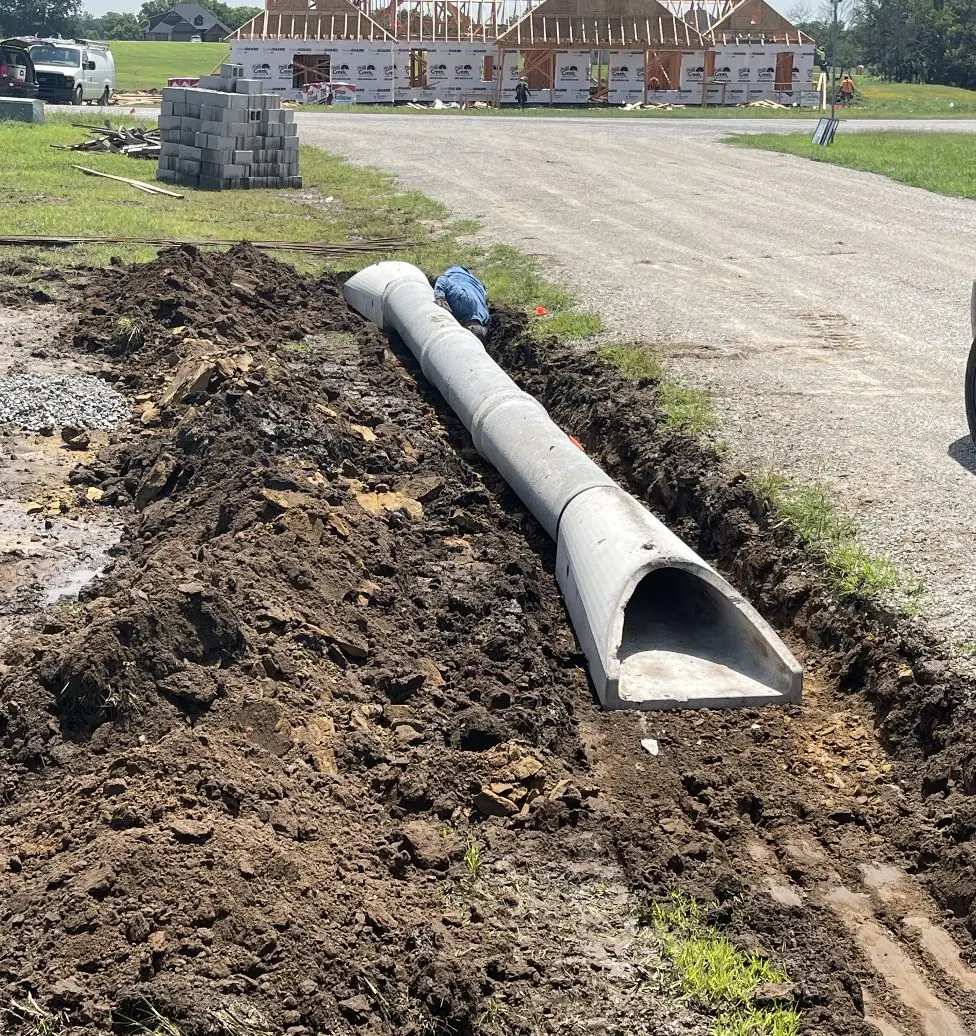
Clay has tiny pore spaces, so it takes in water slowly. When rain falls faster than clay can absorb it, the extra water either runs off the surface or sits on top. That is why a clay yard can flood in a storm that a sandy yard would shrug off, and why water that reaches a foundation in clay does not simply soak away.
Dry clay can also crack, and those cracks swallow water quickly in a dry spell. That fools a lot of homeowners into thinking a yard drains well in August and badly in April. If you want to know what is under your own lot, the USDA Natural Resources Conservation Service runs the Web Soil Survey, where you can draw your property on a map and read the soil description. Treat it as a guide and confirm with what comes out of the ground.
Simple checks before anyone digs
Go outside during a real rain, not after it. Watch where the water comes from and where it goes. Is it running off the roof and dumping at the base of a downspout? Is it coming across the yard from the neighbour's side or from the street? Is it pooling in one spot and staying there?
Then look the day after. Surface water that drains away within a day points toward a grading problem. Ground that is still soft and wet two or three days later points toward a subsurface problem. Take short videos on your phone; they help more than any description. Check the downspouts too, because a downspout emptying against the foundation is one of the most common causes of a wet wall, and a buried extension or a splash path away from the house is sometimes the first step. The guide to drainage problems in Tulsa yards walks through more of these signs.
Where the water is allowed to go
Whichever fix you choose, the water has to end up somewhere that is not your neighbour's yard. Typical outlets are daylight at a lower point on your own lot, a roadside ditch, or an existing storm outlet. Pushing water onto the next property simply moves the problem and can start a dispute.
Inside Tulsa city limits, the City says a Watershed Development Permit is required before development that includes earth change, excavating, grading or regrading. Ask the City through 311 or Development Services whether your job needs one before any work starts. The City also says its stormwater engineers can make site visits and suggest ways to address private drainage problems, which is worth a call if water is crossing property lines. Outside the city, ask your town or Tulsa County which office handles it.
When the answer is both
Many clay yards end up with a combination: the surface is regraded so most of the water runs off, and a French drain picks up what still soaks in along the low side of the house or at the toe of a slope. Doing both at once usually makes sense, because the machine is already there and the regrading can be shaped to feed the drain rather than fight it.
What you want to avoid is paying for a drain when a few loads of dirt moved the right way would have done the job, or regrading a yard that will still be wet underneath. That decision is made by looking at the ground, not by reading a quote. For how price fits into it, see what moves French drain cost in Tulsa.
Get it looked at before you choose
Justin starts by tracing the water: its source, its path and its possible exits, and only then recommends a drain, regrading or both. On a walk-through he will look at the slope around the house, the downspouts, the low spots, the likely outlet and the access for a machine, and tell you plainly which fix fits the problem.
Before any digging, underground lines need to be located through OKIE811, and OKIE811 asks for requests at least three business days ahead. Call Justin at (918) 240-3392 to set up a walk-through, and bring the rain videos if you have them. It is the quickest way to stop guessing and get water moving away from the house.
The Short Version
- Water running across the surface toward the house usually calls for regrading.
- Ground that stays soggy for days, or water entering from below, usually calls for a French drain.
- Clay takes water in slowly, so both problems are common around Tulsa, and many yards need both fixes.
- Every fix needs a legitimate outlet; ask the City of Tulsa through 311 about permits and private drainage advice.
- Watch your yard during a rain, take videos, and have Justin walk it before you pick a fix.
Quick Answers
Can regrading alone stop water getting against my foundation?
Often, yes. If the ground has settled so it falls toward the house, putting the slope back so it runs away is frequently the whole fix. If the soil stays wet underneath after the surface is right, a drain is added.
Is clay soil the reason my yard holds water after rain?
It is a common reason. Clay takes water in slowly, so heavy rain runs off or sits on top. Grading that sends water off the lot, or a drain that collects it below ground, deals with what the clay cannot absorb.
Who can tell me if regrading my Tulsa yard needs a city permit?
Ask the City of Tulsa through 311 or Development Services. The City lists grading and regrading among the work covered by its Watershed Development Permit, so confirm before work starts.
Will a French drain work if my yard is completely flat?
Only if there is a lower outlet somewhere the pipe can reach with enough fall. On a flat lot the outlet is the first thing to find. If there is nowhere for the water to go, you should be told that before any trench is dug.
See the drainage & french drains service or call (918) 240-3392.