

Preparing raw land to build follows a set order: settle the lines and the permits, clear only what the build needs, cut the access drive, then build the pad, run the trenches and shape the drainage. Doing it in that order means a machine crosses the ground once for each job instead of tearing up work that is already finished.
Questions to answer before the first tree comes down
Know where your lines are. A survey shows the property corners, and any easements or setbacks the builder has to respect. Then put the plan on the ground: where the house, the shop, the drive, the water line, the power and the wastewater system will go. Stakes and paint on the ground answer questions that a drawing does not.
If the house will not be on a city sewer, the area for an on-site wastewater system needs to be chosen and protected early. The Oklahoma Department of Environmental Quality runs the on-site sewage programs, including a program that trains soil profilers to do the soil profile tests these systems are designed from. Ask DEQ what applies to your property before the pad location is fixed, and keep machines off that area once it is chosen.
Permits and the offices to ask
Inside the City of Tulsa, the City says a Watershed Development Permit must be obtained before any development starts, and that erosion and sediment control plans go with applications for permits that disturb bare earth. Sites disturbing one acre or more also need state OKR10 coverage and a Storm Water Pollution Prevention Plan. The Development Services Permit Center on East 2nd Street is the place to ask.
Outside Tulsa, ask your own city or town, or Tulsa County, Creek County, Rogers County or whichever county covers unincorporated ground. If the drive will meet a county road, ask the county about the approach and any culvert before it is built. Rules change, so confirm with the office that covers your address before work is scheduled. And before any digging at all, a locate request goes in through OKIE811.
Step one: clear what the build needs
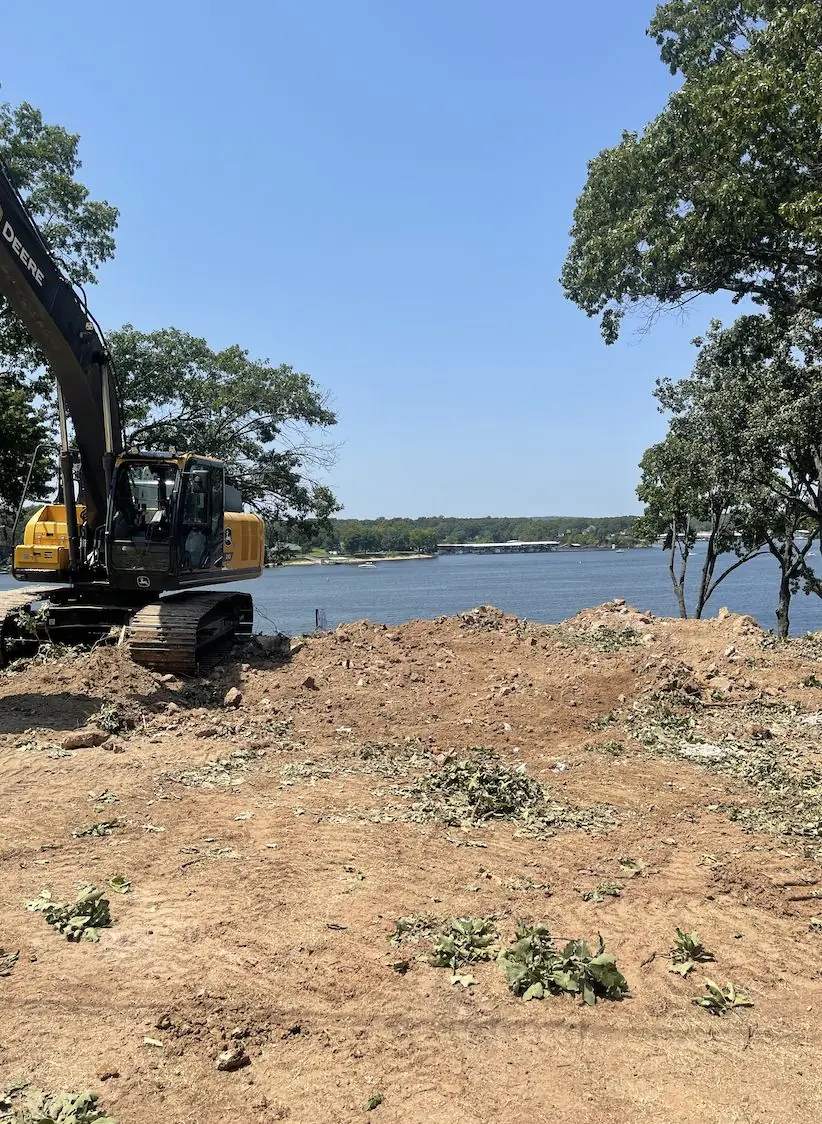
Clear the house footprint, the drive, the utility routes and enough working room around them for trucks and machines. Leave the trees you want to keep, and mark them so nobody guesses. Trees close to the house site may be worth taking now, because roots under a future slab and limbs over a future roof are harder to deal with later.
Plan where the brush goes before the clearing starts: piled, hauled off or dealt with on site where rules allow. The land clearing page covers the clearing itself. If you are deciding who to hire to clear land, a dirt contractor who also does the drive and the pad can clear with the next steps in mind instead of leaving stumps and ruts in the way.
Step two: the access drive
Concrete trucks, rock trucks and lumber deliveries all need a solid way in. On clay, a drive that is not built yet turns into a rut the first time it rains, and every truck after that makes it worse. Cutting the drive early, with base rock and a proper approach at the road, keeps the job moving through wet weather.
The drive should be cut to grade, based, crowned and compacted, with a culvert where it crosses a ditch. Building it right the first time also means it only needs a surface dressing once construction traffic is done, rather than a rebuild. See gravel driveway installation for what goes into a drive that holds up.
Step three: the building pad
With access in, the pad comes next. Topsoil is stripped and set aside, the site is cut and filled to the grade the builder needs, and the fill is placed in layers and compacted so the slab or foundation does not settle. The pad is shaped so water runs away from it on every side.
The details of cut, fill, compaction and soil checks are in the building pad guide. The point to remember here is order. A pad built before the drive gets rutted by every truck coming in. A pad built after the trenches means digging back through finished, compacted ground.
Step four: trenches for utilities
Water, sewer and electric lines usually run from the road or the meter to the house site, and often on to a shop or barn. Trenching them before the final grading means the trench lines get compacted and graded over with everything else instead of sinking later across a finished yard.
The plumber and the electrician make the connections, and the trenches are scheduled so nobody is standing around waiting. Trenches need to be bedded, backfilled and compacted properly, especially where they cross the drive. See underground utility trenching for how that work is done.
Step five: drainage and final grade
Drainage is planned at the start and finished at the end. Once the heavy traffic is over, the ground around the house is shaped so it falls away from the foundation, swales carry water around the house, and culverts and ditches move it past the drive. Doing this last means trucks do not undo it.
Justin works through the whole order on raw ground around Tulsa, from clearing to the drive, the pad, the trenches and the final grade, so one person is thinking about how each step affects the next. Call Justin at (918) 240-3392 to walk your property and talk through the sequence before you book anything.
The Short Version
- Settle the survey, the site plan and the permit questions before clearing starts.
- Inside Tulsa, ask the Permit Center about the Watershed Development Permit first.
- Clear only what the build needs, then cut the access drive before the pad.
- Run utility trenches before final grading so they settle with everything else.
- Shape the final drainage last, once the heavy trucks are gone.
Quick Answers
Should the driveway go in before the house pad?
Usually yes. Every truck that delivers rock, concrete or lumber needs a solid way in, and a drive built first keeps the site working through wet weather instead of turning it into ruts.
How much of my land should be cleared to build a house?
Enough for the house, the drive, the utility routes and working room for trucks and machines. Everything else can stay. More can be cleared later, but trees cannot be put back.
Who connects the water and electric after the trenches are dug?
The plumber and the electrician, or your utility provider, make the connections. The dirt contractor digs, beds and backfills the trench, and the two get scheduled together.
Can site preparation be done when the ground is wet?
Some of it can, but wet clay ruts easily and does not compact well, so pad work in particular usually waits for drier ground. An access drive built early helps keep the rest of the job moving.
See the land clearing service or call (918) 240-3392.