

For most driveways the right choice is crushed, angular rock with fines in it, laid as a coarser base under a finer surface layer, because broken faces lock together and the fines bind them, while rounded pea gravel and river rock roll under tires. The rock only works if the drive underneath is crowned and drained, so choosing the gravel and fixing the drainage are one decision.
Crushed rock or round gravel
The single biggest choice is shape. Crushed stone is quarried rock broken in a crusher, so every piece has sharp, fractured faces. Gravel from a river or pit is shaped by water and tends to be rounded. For a driving surface, that difference decides whether the rock stays put.
Angular pieces lock against each other when they are compacted, the same principle old macadam roads relied on. Rounded pieces act like ball bearings: they roll and shift under tires, ruts form quickly and the rock spreads into the grass. Guidance on gravel roads says the same thing plainly, that gravel with fractured faces stays in place better than rounded river pebbles. For a driveway in Oklahoma that has to carry cars, trucks and the odd delivery, crushed rock is the starting point.
Base layer and surface layer
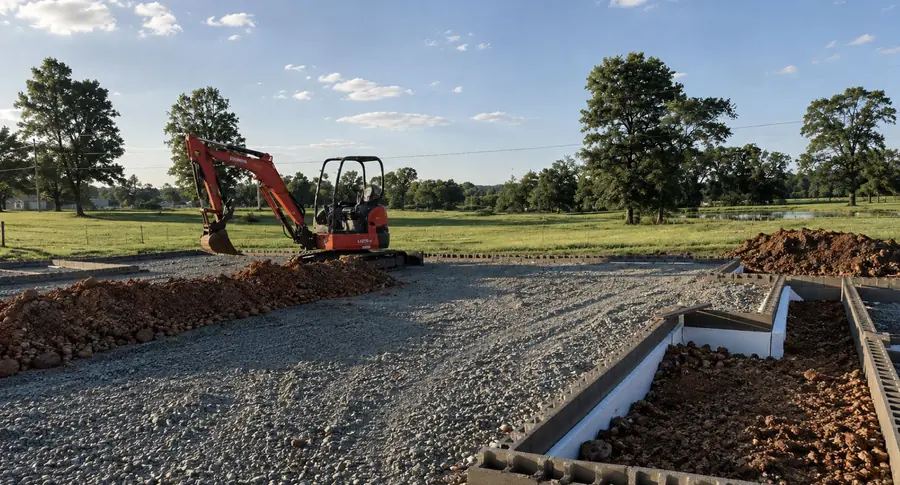
A gravel driveway that lasts is built in layers. The base is coarser crushed rock, spread and compacted over a prepared subgrade. It carries the weight and spreads it out so the clay underneath does not rut. The surface layer is finer crushed rock that compacts into a tight, drivable top and fills the gaps in the base.
Skipping the base and laying surface rock straight on clay is the most common reason a new drive sinks, ruts and needs topping up every spring. On soft or wet ground, the base may need to be thicker, and the subgrade may need fixing first. How much base goes down is one of the main things that moves the price, as the gravel driveway cost guide explains.
Why fines matter
Fines are the small particles and dust that come with crushed rock. They are not dirt to be washed out. On an unpaved surface, fines act as a binder, filling the spaces between larger pieces and helping the surface pack hard. Rock with a good mix of sizes, down to fines, compacts into a surface that sheds water and resists rutting.
Clean, washed rock with no fines drains freely, which makes it right for a French drain, but on a drive it stays loose and moves under tires. Too many fines go the other way and turn slick or muddy when wet. The aim is a graded mix of sizes, which is why the rock sold for road and drive surfaces is usually unwashed crushed rock rather than washed drainage rock.
Rock that works poorly on a drive
Pea gravel is small and round. It looks tidy but rolls underfoot and under tires, ruts easily and drifts into the lawn. River rock and decorative stone have the same problem, often worse. Both have their place in paths, beds and around downspouts, but not as the main driving surface.
Very large rock on its own is hard to drive on and does not form a smooth top, so it belongs in the base or in a culvert approach, not on the surface. Mixing leftover landscape rock into a drive rarely helps either. A drive does better with the right crushed base and surface rock than with whatever rock is closest to hand.
Names at the rock yard
Rock yards and quarries sell driveway rock under their own names, and the same name can mean slightly different rock from one supplier to the next. You will hear terms such as base, crusher run, screenings, chips and washed rock. Rather than trusting the name, ask what the rock is, whether it is crushed or rounded, the size range, and whether it has fines in it or has been washed.
Tell the supplier what it is for: base under a drive, the driving surface, or drainage. A good rock yard will steer you to the right product. If a contractor is building the drive, they will usually know which local products compact well and which turn to mud or roll loose.
The crown and drainage keep the rock in place
The right rock on a flat drive still fails. Water that stands on a gravel surface softens the base, and every car pushes rock out of the soft spot. A crown, a raised center that sheds water to the sides, and ditches or culverts that carry it away, are what keep the gravel where it was laid.
That is why a drive that keeps washing out is almost always a water problem, not a rock problem. New rock on top of a drive with no crown and no drainage is money spent twice. See gravel driveway installation for how a drive is cut, based and crowned, and gravel driveway repair for fixing one that has already failed.
Ask Justin which rock fits your drive
Justin builds and rebuilds gravel drives across Tulsa and northeast Oklahoma: cut to grade, based, crowned and compacted so water sheds off instead of standing. He looks at the ground underneath, the slope, the traffic and where the water goes, then talks through which base and surface rock suit that drive.
If the drive is worn out rather than new, he checks whether the base is still sound or whether the potholes and ruts go deeper than the surface, because fresh rock over a failed base does not last. Call Justin at (918) 240-3392 to walk your drive, new or worn out, and get a straight answer on what it needs.
The Short Version
- Use crushed, angular rock for a driveway; rounded pea gravel and river rock roll and rut.
- Build in layers: a coarse compacted base under a finer surface rock.
- Fines bind a gravel surface; washed rock suits drains, not drives.
- Ask suppliers what the rock is rather than trusting the product name.
- A crown and working drainage keep any gravel in place.
Quick Answers
Is pea gravel a good choice for a driveway?
Not as the driving surface. Pea gravel is small and round, so it rolls under tires, ruts and drifts into the lawn. Crushed rock with fines locks together and holds.
What is crusher run?
It is a common yard name for crushed rock mixed with the fines from crushing, used for bases and drive surfaces because it compacts hard. What it contains varies by supplier, so ask about the size range.
Should driveway rock be washed or unwashed?
For the driving surface and base, usually unwashed crushed rock, because the fines bind it together. Washed rock drains freely and suits French drains and other drainage work.
How often does a gravel driveway need new rock?
It depends on traffic, slope and drainage. A drive with a good base, a crown and working ditches needs only light dressing now and then. One that needs rock every spring usually has a water problem.
See the driveways service or call (918) 240-3392.