

Sometimes, but around Tulsa the rules are tighter than most people expect. The Oklahoma DEQ calls for an air curtain incinerator for land clearing burns in the Tulsa metro counties, no burning is allowed during a burn ban, and you should check the current burn ban status with Oklahoma Forestry Services and your local fire department on the day you plan to burn.
Who sets the burning rules in Oklahoma
Two state agencies matter here. The Oklahoma Department of Environmental Quality, usually called DEQ, writes the open burning rules that cover what can be burned, where and how. Oklahoma Forestry Services, part of the Oklahoma Department of Agriculture, Food and Forestry, puts out the state's guidance on burning within the law and links a current burn ban map from its pages on ag.ok.gov.
On top of the state rules, the Forestry Services guidance notes that local entities may impose stricter requirements on open burning. So a city, a fire district or a county proclamation can all add limits. The safe order is to read the state rules, check the burn ban status, then ask your local fire department or city before you light anything. This guide is a starting point, not a permit, so confirm with them.
Land clearing burns in the Tulsa metro counties
The DEQ's open burning fact sheet lists land clearing as a type of burning that can be allowed, with a catch for the two big metro areas. In the Tulsa metropolitan area, which the sheet lists as Creek, Okmulgee, Osage, Pawnee, Rogers, Tulsa and Wagoner counties, land clearing burns call for an air curtain incinerator, a purpose-built unit that controls smoke and particulates.
That covers most of the Tulsa area. The same fact sheet says yard brush may be burned on the property where it grew, that brush cannot be hauled to another property to be burned except under those rules, and that tires, rubber and plastic must never be burned. No burning is allowed during a burn ban or during an Ozone or PM Alert for the county. Check the DEQ rules at deq.ok.gov for your situation.
Burn bans: governor and county
Oklahoma has two kinds of burn ban. According to Oklahoma Forestry Services, a governor's burn ban prohibits controlled burning and prescribed fire. A county commissioners' burn ban restricts open burning, with any exceptions spelled out in that county's proclamation, so read the proclamation itself rather than relying on what a neighbour heard.
Burn bans come and go with drought and fire weather, and a county can go from no ban to a ban in a matter of days. That is why a status you checked last week is not good enough. Check the current burn ban map linked from Oklahoma Forestry Services on the morning you plan to burn, and call your local fire department as well. If you cannot confirm it is allowed, do not burn.
Red Flag Warnings and staying with the fire
A Red Flag Warning is not a burn ban, but it means critical fire weather. The Forestry Services sheet warns that a person could be considered willfully or grossly negligent if a burn escapes after being lit during one. Dry grass, low humidity and Oklahoma wind can turn a brush pile into a grass fire very quickly.
Whoever lights a fire has to stay with it until it is out. State law also lets agencies and fire departments charge for the reasonable costs of putting out an illegal or escaped burn, and burners are not exempt from damages their fire causes. Keep water and tools nearby, keep the pile away from buildings and fence lines, and do not burn on a windy day. Smoke drifting over a neighbour's house can also count as a nuisance under the DEQ rules.
Inside city limits
Towns and cities can be stricter than the state, and many have their own rules about outdoor burning inside city limits. If the property is in Tulsa, Broken Arrow, Jenks, Bixby, Owasso, Sand Springs, Sapulpa or any other town, ask that city or its fire department before you plan to burn anything, even a small pile of yard brush.
Outside city limits, the county and the local fire department are the people to ask. Tell them what you want to burn, how much there is and where it is. If the DEQ's air curtain rule applies to your clearing job, they can point you in the right direction. If the answer is no, that is useful to know before the brush is piled where a fire was going to be.
Other ways to deal with brush from a clearing job
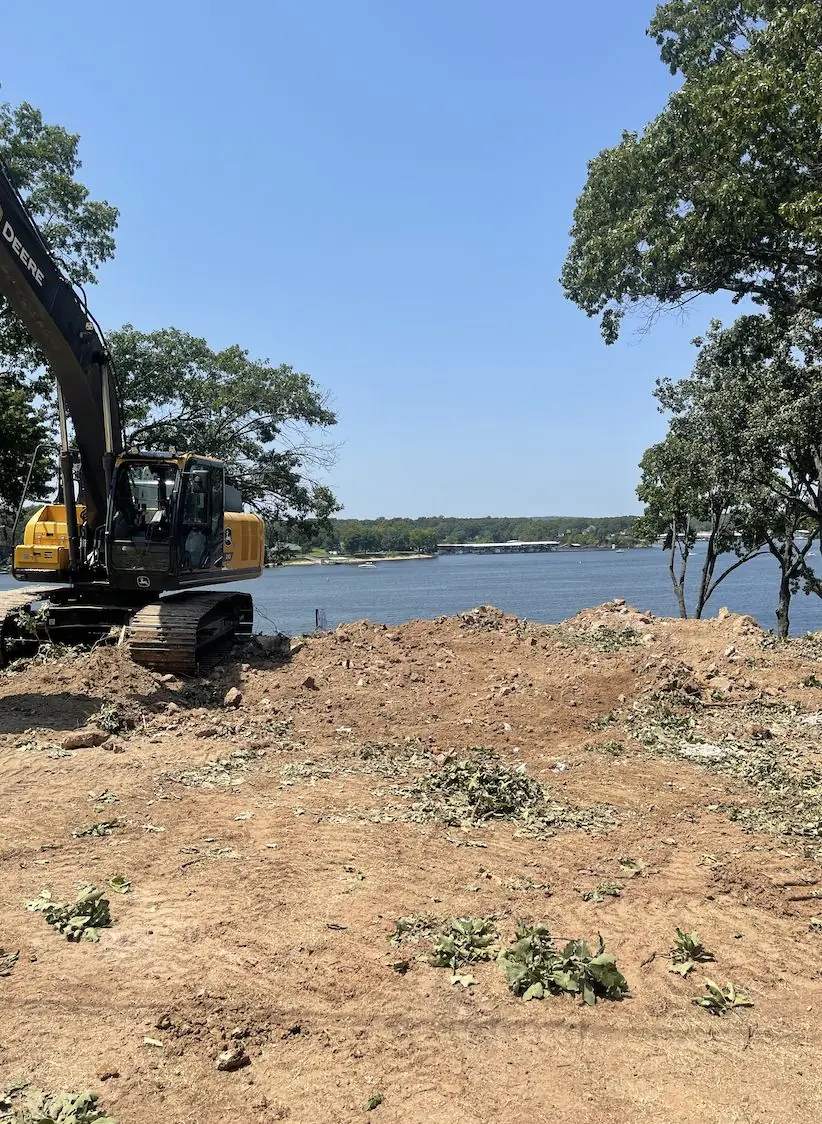
Burning is only one of the options, and around Tulsa it is often not the simplest. Brush can be pushed into piles and left on your own ground, which costs the least machine time and suits plenty of rural property. It can be loaded and hauled off. Or it can be burned where and how the rules allow.
On a land clearing job with Earthworks by Justin, what happens to the material is decided during the estimate, because it changes the price and the plan. The guide to land clearing cost in Tulsa explains how. For a walk-through, call Justin at (918) 240-3392, or read more about land clearing in Tulsa.
The Short Version
- DEQ open burning rules call for an air curtain incinerator for land clearing burns in the Tulsa metro counties.
- No burning during a burn ban or an Ozone or PM Alert for the county.
- A governor's ban prohibits controlled burning. A county ban restricts it, with exceptions in the proclamation.
- Check the Oklahoma Forestry Services burn ban map and your local fire department on the day.
- Brush can also be piled or hauled off. Decide at the estimate, because it changes the price.
Quick Answers
Can I burn brush during a county burn ban in Oklahoma?
A county commissioners' burn ban restricts open burning, and any exceptions are written into that county's proclamation. Read it and ask your local fire department. If you cannot confirm it is allowed, do not burn.
Does a Red Flag Warning mean burning is banned?
Not by itself, but it means critical fire weather. Oklahoma Forestry Services warns that lighting a burn during one and letting it escape could be treated as willful or gross negligence.
Where do I report illegal open burning in Oklahoma?
The Oklahoma DEQ takes open burning complaints on its hotline at 1-800-522-0206. If a fire is out of control, call 911.
See the land clearing service or call (918) 240-3392.